 EuclidzEuclidz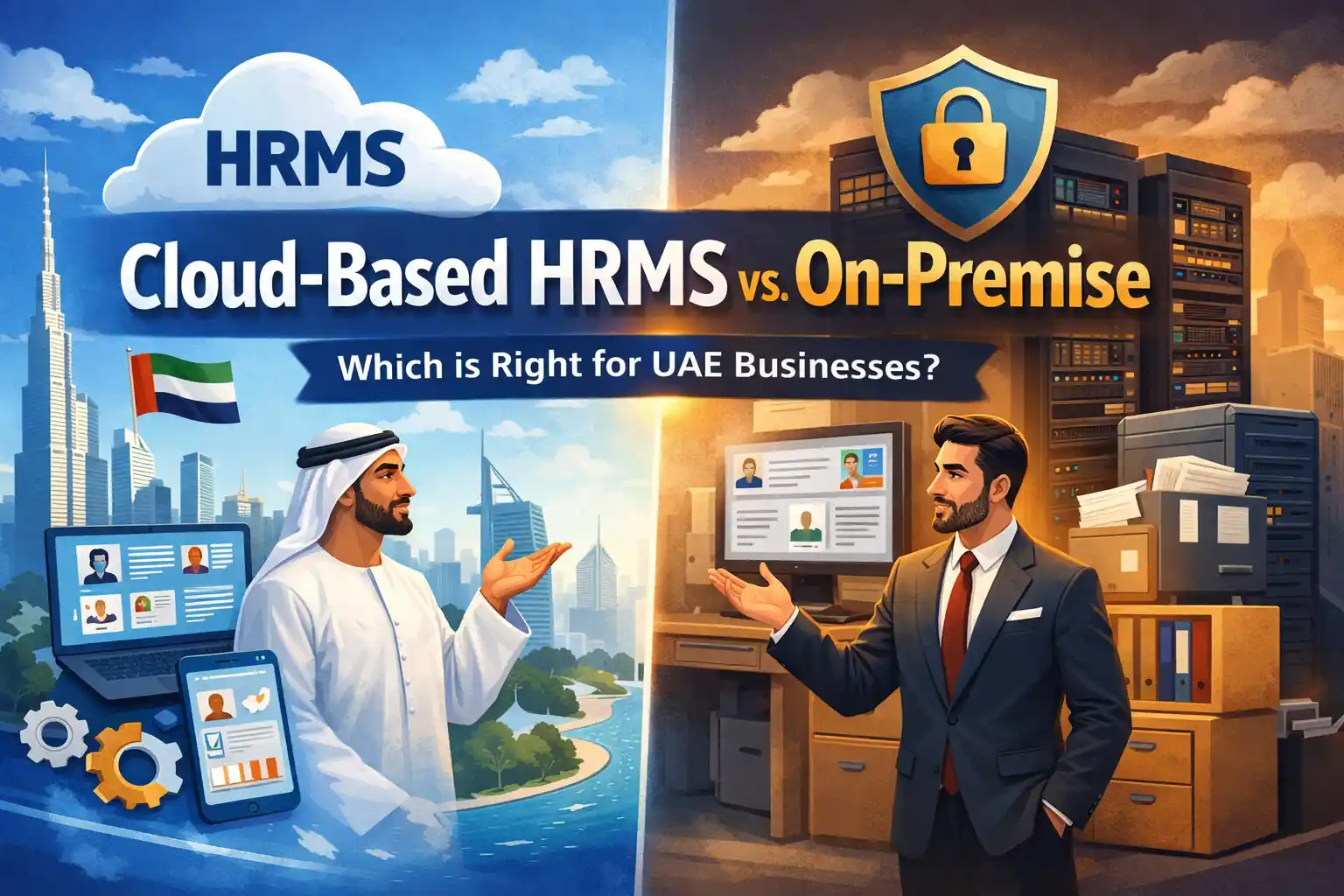
Managing a workforce in the UAE is not a simple task. Between the high volume of expatriate employees, strict WPS compliance, gratuity calculations, and the ever-evolving labour laws, businesses need an HR system that does more than just store employee records. They need a system that works as hard as they do.
That brings us to one of the most debated questions in the HR technology space right now: Should UAE businesses invest in a cloud-based HRMS or stick with an on-premise solution?
There is no universal answer. The right choice depends on your company size, IT infrastructure, budget flexibility, and long-term growth plans. This blog breaks down both options so you can make an informed decision.
A cloud-based Human Resource Management System is hosted on remote servers and accessed through the internet. You do not need to install anything locally — your HR team can log in from any device, anywhere. The software vendor manages all updates, security patches, and server maintenance on your behalf.
Popular examples include SAP SuccessFactors, Oracle HCM Cloud, and regionally tailored platforms built specifically for the GCC market.
An on-premise HRMS is installed and operated directly on your company's own servers within your physical office or data centre. Your internal IT team is responsible for maintenance, upgrades, and data security. You own the licence and have full control over the system environment.
This is often the first factor businesses look at — and rightly so.
Cloud-based HRMS typically operates on a subscription model (SaaS), where you pay a monthly or annual fee per employee or user. There are minimal upfront costs, which makes it accessible for startups and SMEs. However, over a decade, the cumulative subscription costs can exceed what you would have paid for a perpetual on-premise licence.
On-premise HRMS requires a significant upfront capital investment — software licences, server hardware, and IT resources. But once deployed, the ongoing costs are relatively lower. For large enterprises with hundreds of employees already running a robust IT department, this can be cost-effective in the long run.
Verdict for UAE businesses: For SMEs and growing companies, cloud wins on cost entry. For large enterprises with existing IT infrastructure, on-premise may offer better total cost of ownership.
A cloud HRMS can typically be up and running within a few weeks. Vendors handle the technical heavy lifting, meaning your HR team can start processing payroll and managing leave policies almost immediately.
On-premise implementations are more complex. Depending on the scale of customisation and data migration, they can take several months. This is a critical consideration if your business is scaling quickly or if you have urgent compliance deadlines to meet.
This is where many international HR platforms fall short. UAE labour law has very specific requirements — Wage Protection System (WPS) integration, end-of-service gratuity calculations as per the UAE Labour Law, Emiratisation (Nafis) tracking, and multi-currency payroll for a diverse workforce.
Both cloud and on-premise solutions can support UAE compliance, but the speed of compliance updates differs significantly. With a cloud-based platform, vendors push regulatory updates automatically. When the UAE Ministry of Human Resources and Emiratisation releases new guidelines, your system updates without manual intervention.
On-premise users, by contrast, often need to wait for a new software version or engage their IT team to manually apply patches — a process that can leave the business exposed during the transition period.
This is a major reason why businesses searching for reliable HRMS Software in Dubai are increasingly favouring cloud-first solutions that are updated in real time with local regulatory changes.
Data privacy is a genuine concern for many UAE businesses, particularly those in finance, healthcare, and government-adjacent sectors.
On-premise HRMS gives you complete control over where your data lives and who can access it. For organisations that handle sensitive employee data and must comply with specific data residency requirements, this level of control is appealing.
Cloud providers have responded to these concerns aggressively. Most enterprise-grade cloud HRMS platforms now offer UAE or GCC-region data centres, ensuring your employee data does not leave the region. They also invest heavily in encryption, multi-factor authentication, and ISO/IEC 27001-certified security standards — often far beyond what an individual company's IT team can maintain in-house.
The UAE's business environment is dynamic. Companies expand across emirates, open regional offices in Saudi Arabia and Qatar, and manage a mobile workforce that spans construction sites, corporate offices, and remote locations.
Cloud-based HRMS scales effortlessly. Add new employees, open a new branch, or expand to a new country — the system grows with you without additional hardware costs.
On-premise systems require additional server capacity, IT resources, and time to scale. Remote access is also limited unless you invest in a VPN infrastructure, which adds both cost and complexity.
Here is a straightforward breakdown:
| Factor | Cloud-Based HRMS | On-Premise HRMS |
|---|---|---|
| Upfront Cost | Low | High |
| Ongoing Cost | Subscription-based | Lower after setup |
| Implementation Speed | Weeks | Months |
| UAE Compliance Updates | Automatic | Manual/delayed |
| Data Control | Shared (region-hosted) | Full |
| Scalability | High | Limited |
| Remote Access | Anywhere | Restricted |
| Best For | SMEs, growing businesses | Large enterprises with IT teams |
At Euclidz Technologies, we work with businesses across the UAE — from startups in Dubai Internet City to mid-sized manufacturing companies in Sharjah's industrial zones. What we consistently see is that most UAE businesses today benefit more from a cloud-based HRMS, primarily because of the agility it offers in a fast-moving regulatory environment.
That said, we do not take a one-size-fits-all approach. If your organisation has specific data sovereignty requirements or a mature in-house IT team, an on-premise or hybrid deployment may serve you better.
The most important thing is to choose a system that is built with the UAE market in mind — one that understands WPS, gratuity, and the nuances of managing a multicultural workforce.
ERP software delivers clear business benefits.
Whether you are evaluating cloud options or looking at a full on-premise deployment, Euclidz Technologies can help you assess the right fit. Our team specialises in HR technology solutions designed specifically for the GCC market.
Explore our HRMS Software in Dubai solutions and get in touch with our team for a no-obligation consultation. The right HR system is not just a software decision — it is a strategic one.