 EuclidzEuclidz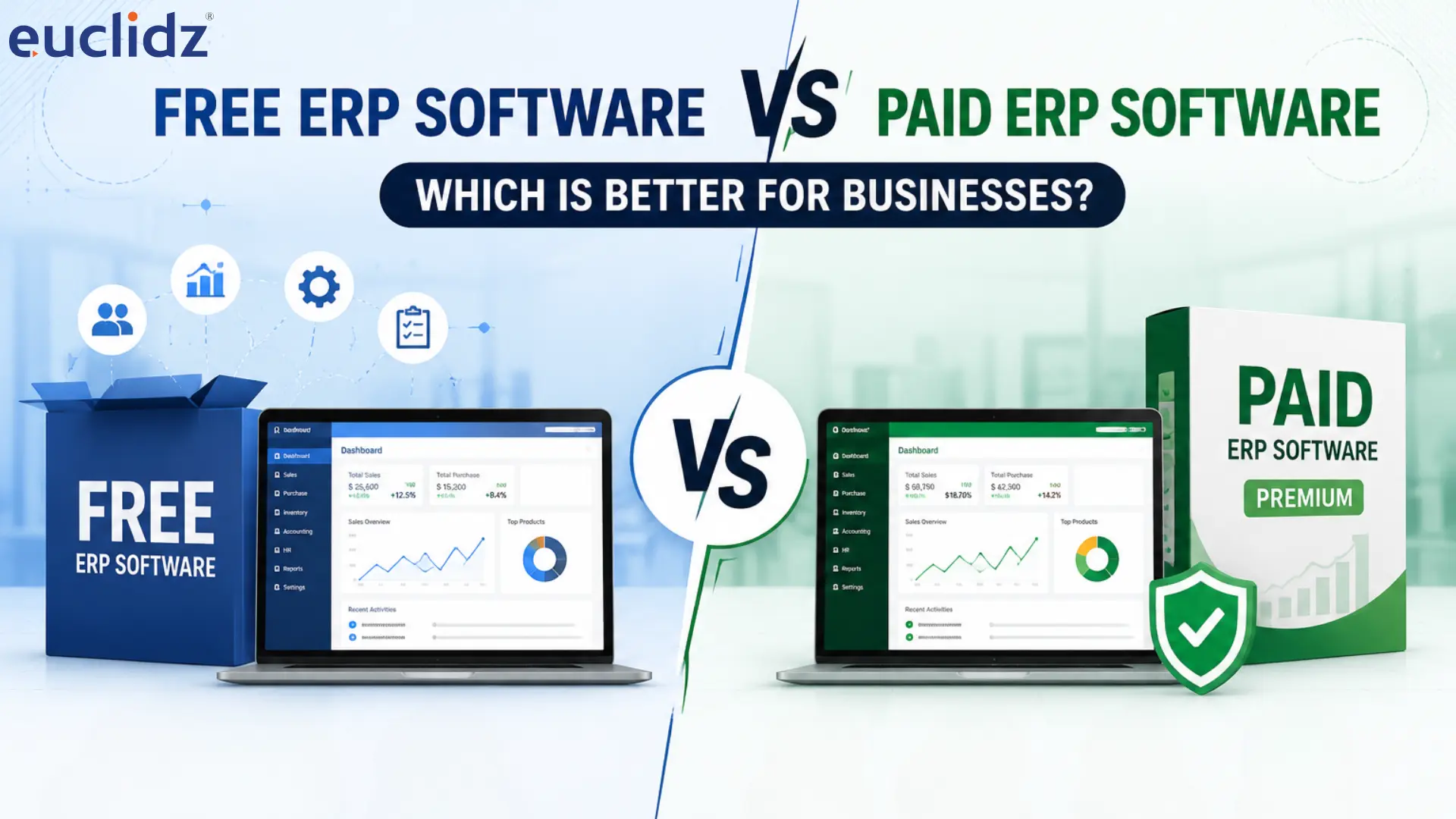
Businesses today operate in an increasingly competitive environment where efficiency, automation, and real-time decision-making are essential for growth. Whether you're a startup, SME, or large enterprise, implementing an Enterprise Resource Planning (ERP) system can significantly improve your operations by integrating finance, sales, inventory, HR, procurement, manufacturing, and customer management into one centralized platform.
However, one important question often arises before investing in an ERP solution:
Should you choose free ERP software or paid ERP software?
At first glance, free ERP software seems like the obvious choice because it eliminates licensing costs. But is it truly free in the long run? On the other hand, paid ERP software requires an upfront investment but often delivers greater functionality, security, support, and scalability.
In this comprehensive guide, we'll compare free ERP software and paid ERP software from every angle, helping you determine which option is best for your business. If you're planning to invest in ERP software, this guide will provide the insights you need to make an informed decision.
Enterprise Resource Planning (ERP) software is a business management solution that connects multiple departments into a single integrated platform.
Instead of using different software for accounting, inventory, HR, CRM, payroll, procurement, and manufacturing, an ERP system brings everything together.
Typical ERP modules include:
By eliminating disconnected systems, businesses gain improved visibility, fewer errors, and better productivity.
Free ERP software refers to ERP solutions that can be downloaded and used without purchasing expensive licenses.
Many free ERP systems are open-source, allowing businesses to modify the source code according to their specific requirements.
Examples include:
Although these platforms are free to download, implementation, customization, hosting, maintenance, and support often come with additional costs.
Paid ERP software is a commercial ERP solution offered through licensing or subscription models.
These systems usually provide:
Popular paid ERP platforms include:
These solutions are designed for businesses that require enterprise-level performance and long-term scalability.
| Feature | Free ERP Software | Paid ERP Software |
|---|---|---|
| Initial Cost | Very Low | Higher |
| License Fee | Free | Subscription or One-Time License |
| Customization | High (Open Source) | High with Professional Support |
| Technical Support | Community Forums | Dedicated Vendor Support |
| Security | Depends on Setup | Enterprise-Level Security |
| Updates | Manual | Automatic |
| Scalability | Moderate | Excellent |
| Training | Limited | Professional Training |
| Integrations | Limited | Extensive |
| Maintenance | Self-Managed | Vendor Managed |
The biggest advantage is that businesses can start using the software without paying expensive licensing fees.
This makes free ERP ideal for:
Most free ERP systems are open-source.
Developers can:
Businesses have full control over their ERP environment.
Companies exploring ERP for the first time can experiment with free software before investing in enterprise solutions.
Employees can learn ERP processes without making a significant financial commitment.
Popular open-source ERP platforms often have active global communities where users share:
Because businesses own the software, they aren't tied to one vendor.
This offers greater flexibility for future upgrades or migrations.
Despite the advantages, free ERP software has several drawbacks.
Many advanced capabilities are unavailable, including:
Businesses may quickly outgrow these limitations.
Community forums cannot replace professional customer support.
When critical issues arise, businesses often need experienced ERP consultants.
Installing free ERP software usually requires:
Without an IT team, implementation becomes challenging.
Although the software is free, businesses often pay for:
Over time, these costs can exceed commercial ERP licensing fees.
Open-source communities release updates at different schedules.
Businesses may need to manually install updates and test compatibility.
Paid ERP systems include advanced functionality across all departments.
Businesses can manage:
All from one platform.
One of the biggest advantages is immediate assistance from ERP experts.
Support often includes:
Downtime is minimized.
Paid ERP vendors invest heavily in cybersecurity.
Security features typically include:
This is particularly important for businesses handling sensitive financial and customer information.
Businesses receive:
without needing manual intervention.
As businesses grow, paid ERP software grows with them.
New users, departments, warehouses, and international branches can be added with minimal disruption.
Most modern paid ERP systems are cloud-based.
Benefits include:
Licensing, implementation, and training require upfront spending.
However, this investment often delivers long-term operational savings.
Cloud ERP solutions generally charge monthly or annual subscription fees.
Businesses should factor these recurring costs into their budgets.
Enterprise ERP implementations may take several weeks or months depending on complexity.
Proper planning is essential.
Many businesses compare only the purchase price.
Instead, consider the Total Cost of Ownership (TCO).
Hidden expenses include:
A comprehensive cost analysis helps avoid unexpected expenses.
Free ERP software is suitable for:
If your business has simple operational requirements and limited budgets, free ERP can be a practical starting point.
Paid ERP software is recommended for:
Organizations handling large transaction volumes benefit from the advanced capabilities and reliability of commercial ERP solutions.
Paid ERP software generally offers better optimization, resulting in faster processing speeds.
Commercial ERP vendors maintain robust infrastructure and service-level agreements (SLAs), ensuring higher uptime than most self-hosted free ERP solutions.
Paid ERP systems usually provide modern, intuitive interfaces with guided workflows, making them easier for employees to adopt.
Advanced dashboards, AI-powered insights, forecasting, and customizable reports are more common in paid ERP platforms.
Before choosing an ERP system, ask these questions:
Your answers will help determine which ERP model aligns best with your business goals.
Many organizations begin with free ERP software but later transition to paid solutions due to:
As operations become more sophisticated, a commercial ERP often provides greater long-term value.
Selecting the right software is only half the equation. A knowledgeable implementation partner ensures the system is configured to match your workflows, data is migrated accurately, employees receive proper training, and the ERP delivers measurable business outcomes.
If your organization is looking for reliable ERP Software in Dubai, choosing an experienced implementation partner can help reduce deployment time, minimize risks, and maximize return on investment. An expert team can recommend the right ERP platform, customize modules, integrate existing systems, and provide ongoing support as your business grows.
To maximize your ERP investment:
Following these practices improves user adoption and helps businesses achieve faster ROI.
The future of ERP is being shaped by intelligent technologies that help businesses automate routine tasks, gain deeper operational insights, and make faster, data-driven decisions. Some of the most influential innovations include:
Modern paid ERP platforms are rapidly incorporating these innovations, enabling businesses to automate repetitive tasks, gain deeper insights, and make data-driven decisions faster.
Choosing between free ERP software and paid ERP software ultimately depends on your organization's size, budget, technical expertise, and long-term objectives.
Free ERP software is an excellent option for startups and small businesses looking to explore ERP capabilities with minimal upfront investment. However, businesses should carefully evaluate the hidden costs associated with customization, maintenance, hosting, and technical support.
Paid ERP software, while requiring a higher initial investment, offers superior functionality, enterprise-grade security, reliable vendor support, automatic updates, and the scalability needed for growing organizations. For companies planning sustainable growth and digital transformation, a commercial ERP solution often delivers greater long-term value and a stronger return on investment.
If you're ready to streamline operations, improve productivity, and future-proof your business, partnering with experienced professionals for ERP Software in Dubai can ensure a smooth implementation and help you unlock the full potential of your ERP investment.