 EuclidzEuclidz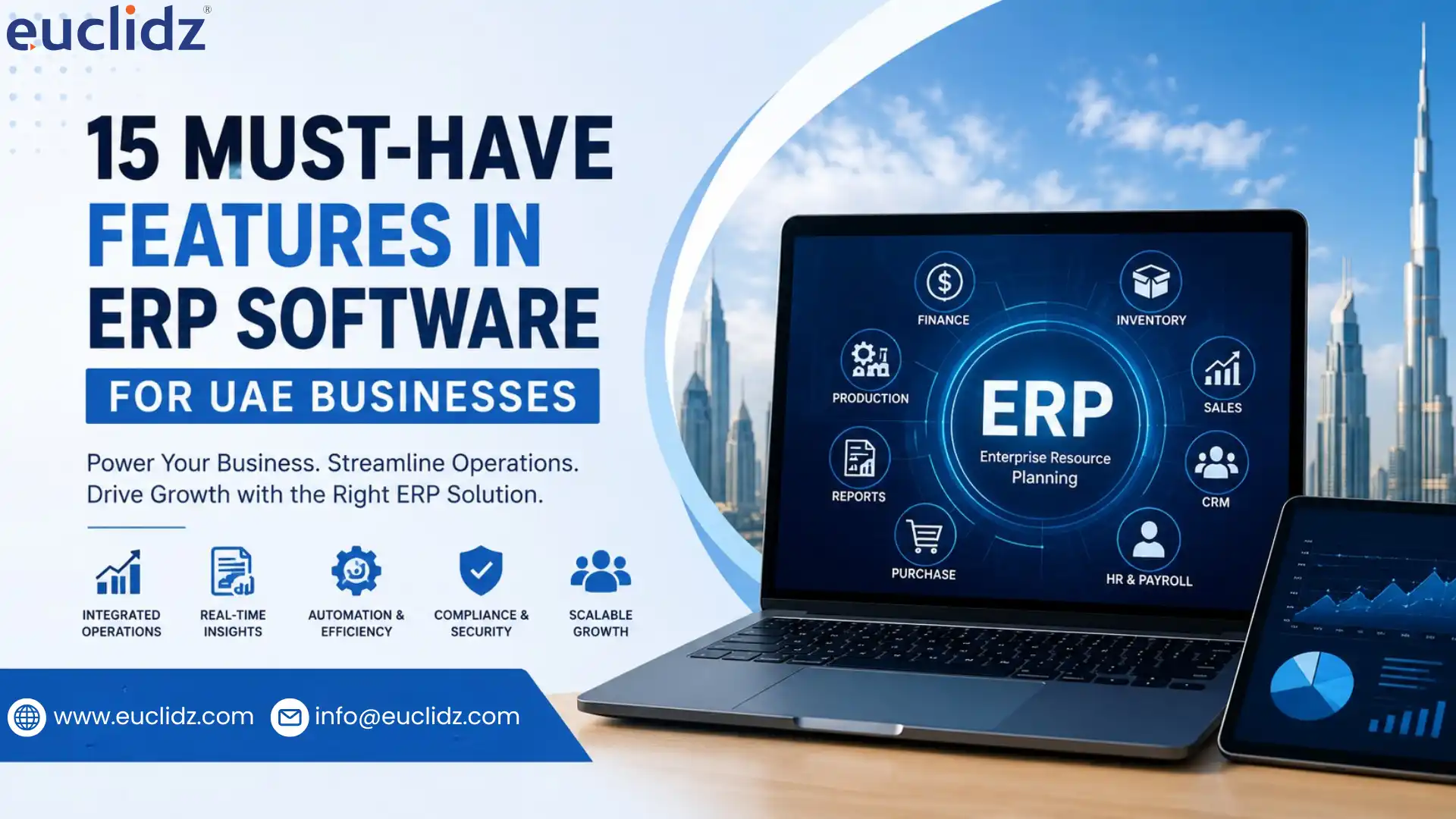
Businesses across the UAE are embracing digital transformation faster than ever before. Whether you operate in retail, construction, manufacturing, healthcare, logistics, hospitality, or professional services, managing multiple business processes manually is no longer sustainable.
As organizations expand, they require a centralized platform that connects finance, inventory, procurement, sales, customer management, human resources, and reporting. This is exactly where ERP software becomes an essential investment.
However, not every ERP solution offers the same capabilities. Choosing software simply because it is affordable or popular may result in expensive customization, limited scalability, and poor user adoption.
Before selecting an ERP system, every business should understand the features that truly matter. In this guide, we'll explore the 15 must-have features in ERP software for UAE businesses and explain why each one is important for long-term business success.
Looking for a reliable ERP Software in Dubai? Discover how Euclidz Technologies delivers customized ERP solutions that help businesses automate operations, improve efficiency, and support sustainable growth.
The UAE continues to attract businesses from around the world, creating a dynamic environment where companies are investing heavily in digital technologies to stay competitive. Companies operate in highly competitive industries while complying with evolving regulations, including VAT, e-invoicing initiatives, payroll requirements, and industry-specific standards.
Modern ERP software enables businesses to:
Instead of using separate applications for accounting, inventory, HR, CRM, and procurement, businesses can manage everything from one integrated system.
One of the most valuable ERP features is the ability to manage all business operations from a single platform.
Without ERP, departments often rely on separate spreadsheets and disconnected software, leading to inconsistent information and communication gaps.
A centralized ERP system brings together:
This gives every department access to accurate, real-time information.
Benefits include:
Finance is the foundation of every organization.
An ERP solution should provide complete financial management capabilities, including:
Instead of manually creating reports every month, businesses receive automated financial insights instantly.
For UAE companies, financial visibility is critical for maintaining healthy cash flow and supporting business growth.
VAT compliance remains one of the most important ERP requirements in the UAE.
Your ERP software should automatically handle:
Manual VAT calculations increase the risk of costly errors and penalties.
A reliable ERP system simplifies tax management while ensuring compliance with UAE regulations.
Inventory directly impacts profitability.
Poor inventory control often results in:
A robust ERP inventory module provides:
Businesses always know exactly what inventory they have and where it is located.
Procurement involves much more than purchasing products.
ERP software should automate the entire purchasing lifecycle, including:
Automation helps reduce purchasing errors while improving supplier relationships.
Winning new customers is important—but retaining existing customers is even more valuable.
Integrated CRM functionality enables businesses to manage:
Sales teams can monitor every stage of the customer journey from inquiry to payment.
This allows sales teams to respond more quickly, build stronger customer relationships, and close more opportunities with greater confidence.
Managing employees manually becomes increasingly difficult as businesses grow.
An ERP should include a complete HR module capable of handling:
For UAE businesses, payroll accuracy is essential.
Integrated payroll minimizes errors while saving significant administrative time.
Business leaders need timely information to make informed decisions.
Modern ERP software should offer customizable dashboards displaying:
Instead of waiting for monthly reports, executives can access live business insights anytime.
Real-time reporting helps identify opportunities before competitors do.
Manual approvals slow business operations.
Workflow automation eliminates repetitive administrative tasks by automating processes such as:
Automation reduces delays while improving accountability.
By reducing repetitive administrative work, employees can focus their efforts on tasks that contribute directly to business growth and operational efficiency.
Today's workforce is increasingly mobile.
Cloud ERP allows employees to securely access business information from:
Benefits include:
Cloud ERP is particularly valuable for businesses operating across multiple UAE emirates.
The ERP you choose today should continue supporting your business five or even ten years from now.
A scalable ERP allows organizations to add:
Instead of replacing software every few years, businesses simply expand their ERP capabilities.
Scalability protects long-term technology investments.
Business data is one of your organization's most valuable assets.
ERP software should include:
Not every employee should have access to financial information or confidential HR records.
Proper security controls reduce internal risks while protecting sensitive business data.
Business doesn't stop when employees leave the office.
Modern ERP software should offer mobile applications that allow users to:
Executives can monitor business performance from anywhere, enabling faster decision-making.
Most businesses already use specialized applications for communication, payments, eCommerce, logistics, or marketing.
An ERP should integrate seamlessly with tools such as:
Integration eliminates duplicate data entry and improves operational efficiency.
Every business has unique operational requirements.
The best ERP software offers flexible customization without affecting future upgrades.
Industry-specific modules may include:
Customization ensures the ERP supports your business processes rather than forcing your team to change established workflows.
Key Factors to Consider Before Selecting an ERP System
With many ERP solutions available, selecting the right platform requires careful evaluation.
Consider the following factors before making a decision:
Request product demonstrations and involve stakeholders from different departments to ensure the ERP meets operational needs.
Many ERP implementations fail because organizations focus only on price rather than long-term value.
Common mistakes include:
Avoiding these mistakes increases the likelihood of a successful ERP implementation.
Implementing ERP software is more than installing a new application. It requires careful planning, process analysis, customization, training, and ongoing support.
At Euclidz Technologies, we help businesses across the UAE adopt ERP solutions that match their operational needs and long-term goals. Our team works closely with clients to understand existing workflows, identify improvement opportunities, and implement systems that enhance efficiency across finance, inventory, procurement, sales, HR, CRM, and project management.
From consultation and implementation to customization, integration, user training, and post-deployment support, Euclidz Technologies provides end-to-end ERP services that enable organizations to streamline operations and improve business performance.
If you're searching for ERP Software in Dubai, Euclidz Technologies offers scalable, cloud-ready ERP solutions designed to support businesses of all sizes while ensuring flexibility, security, and future growth.
ERP technology continues to evolve, offering smarter capabilities that help organizations stay competitive.
Some of the key trends shaping the future include:
Businesses that invest in future-ready ERP platforms will be better equipped to adapt to changing market conditions and customer expectations.
Selecting the right ERP software is one of the most important technology decisions a UAE business can make. A modern ERP system does far more than manage accounting—it connects every critical business function, from finance and procurement to inventory, HR, CRM, and reporting, within a single integrated platform.
The 15 must-have features discussed in this guide—including centralized business management, financial control, VAT compliance, inventory management, workflow automation, cloud accessibility, mobile access, security, integrations, scalability, and industry-specific customization—provide a strong foundation for improving efficiency, reducing operational costs, and supporting long-term growth.
For businesses looking to stay competitive in the UAE's rapidly evolving digital landscape, investing in the right ERP solution is a strategic move rather than just a technology upgrade. By partnering with an experienced implementation provider like Euclidz Technologies, organizations can ensure a smooth ERP journey that delivers measurable business value and positions them for sustained success in 2026 and beyond.