 EuclidzEuclidz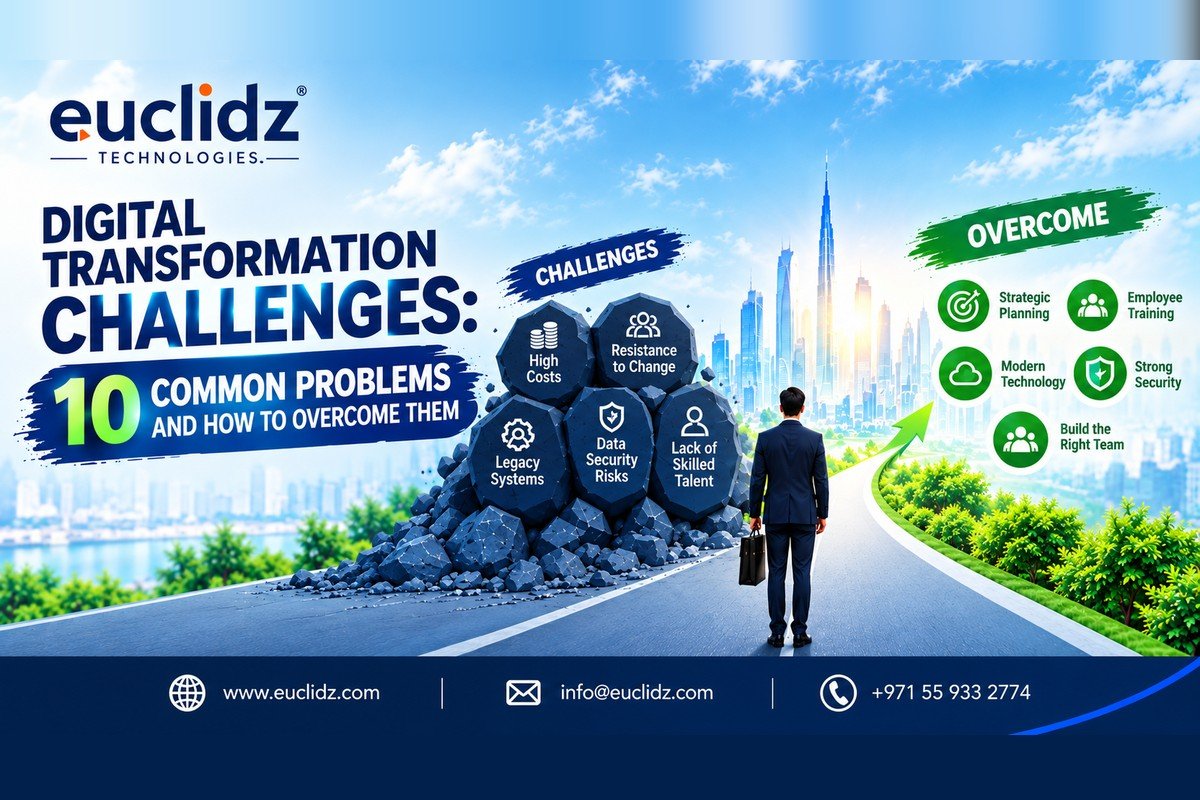
Most businesses don't struggle with digital transformation because they picked the wrong software. They struggle because of people, unclear goals, messy data, and systems that don't talk to each other.
If your team is planning an ERP software rollout, moving away from spreadsheets, or automating approvals, this guide covers the 10 challenges that trip up most organizations and practical ways to handle each one.
Digital transformation means using technology to change how your business runs, manages information, serves customers, and makes decisions. In practice, that can look like:
Moving purchase approvals from paper to a digital workflow is a good step. Connecting procurement, inventory, finance, sales, and reporting through an ERP platform is real transformation.
The question to start with isn't "Which software should we buy?" It's "Which business problems are we trying to solve?"
Every successful transformation rests on four things working together: People + Processes + Data + Technology.
Resistance is the most common problem, and it's understandable. People are comfortable with familiar routines, even slow ones. They may worry a new system will make their job harder, replace their role, or force them to learn something unfamiliar.
When the purpose isn't clear, people quietly keep using spreadsheets, paper records, or side processes next to the new system. That defeats the whole investment.
How to overcome it:
Transformation works best when people take part in the change instead of just receiving new software.
It's tempting to adopt cloud tools, AI, or ERP because everyone else is. But without defined outcomes, you can end up with an expensive system that doesn't fix your biggest problems. A company might buy an advanced analytics platform when the real issue is inaccurate data or disconnected departments.
How to overcome it: Build a strategy that spells out:
For example, a manufacturer trying to cut production delays should focus its roadmap on production planning, procurement, inventory, and shop-floor data, not on whatever technology is trending.
Older accounting software, on-premise applications, and outdated databases often don't integrate well with modern platforms. Some have no APIs at all. Layering new tools on top of old ones usually adds complexity instead of removing it.
How to overcome it: Start with a technology assessment. For each system, decide whether to retain, integrate, modernize, replace, or phase it out. Replacing everything at once is costly and disruptive, so a phased approach lowers both risk and cost.
The goal isn't to replace everything immediately. It's to build a connected, reliable, and scalable environment.
Useful link: Accounting Software vs Traditional Bookkeeping in Dubai
When finance, sales, warehouse, and procurement each keep their own records, you get duplicates, conflicting numbers, and manual reconciliation. Sales may promise a product that the warehouse shows as out of stock. Management gets reports that are late and hand-built.
How to overcome it:
When everyone works from the same information, reporting is more accurate and decisions are faster.
Useful link: 15 Must-Have Features in ERP Software for UAE Businesses
A typical business runs an ERP, CRM, e-commerce site, accounting software, payment gateways, HR tools, and logistics platforms. If they can't communicate, you've just built new silos. Different data formats, customer IDs, and business rules make integration tricky.
How to overcome it: Plan integration before implementation, not after. Focus on API-based connections, clear data mapping, standardized identifiers, thorough testing, error monitoring, and good documentation.
The payoff is a seamless flow: an online order lands in your ERP, updates inventory, triggers fulfillment, and sends financial data to accounting, with no retyping.
You may also like to read: Common HR Challenges in Dubai and How HR Software Solves Them
The software license is only part of the cost. You also need to plan for implementation, customization, data migration, integration, training, infrastructure, support, and future upgrades.
Costs also creep up when requirements are vague, when departments keep adding feature requests mid-project, or when the business over-customizes the software to match every legacy process instead of improving the process itself.
How to overcome it:
A phased rollout lets you show early wins before you expand.
Transformation calls for ERP consultants, developers, data analysts, integration specialists, security experts, project managers, and change management skills. Smaller businesses rarely have all of these in-house.
How to overcome it: Combine upskilling and targeted hiring with external expertise, especially for ERP implementation, data migration, integration, and workflow automation. Just make sure knowledge transfers to your team so you're not dependent on your partner forever.
You may also like to read: Top Advantages of Cloud ERP Software
The more connected your business becomes, the more entry points you create. Customer records, financial data, employee information, cloud apps, APIs, and third-party integrations can all be targets.
How to overcome it: Build security into the plan from the start:
A procurement officer, for instance, doesn't need to see payroll data. Limiting access by role reduces risk without slowing anyone down. Security isn't a feature you add at the end. It's part of the architecture.
Finance wants cost control, sales wants growth, operations wants efficiency, and IT wants stability. Without shared goals, the project fragments, and employees are left wondering why things are changing.
How to overcome it: Agree on shared objectives, assign clear ownership, communicate the "why," set realistic expectations, create feedback channels, review progress regularly, and celebrate measurable wins.
A simple flow to follow: Leadership alignment → Clear objectives → Department ownership → Employee communication → Continuous feedback.
Saying "we implemented an ERP" isn't the same as showing it worked. To prove value, set your KPIs before implementation and compare before and after.
Useful metrics include:
Here's a real-world example. An invoice that once took three days to pass through manual entry, verification, approval, and accounting might take just a few hours after workflow automation. That's a result you can show your leadership team.
Map your current processes and look for manual tasks, repeated work, approval delays, reporting bottlenecks, duplicate data, disconnected systems, and error-prone areas.
You don't need to transform everything at once. Start with projects that are high impact and realistically achievable. Automating invoice approvals, for example, will usually deliver results faster than redesigning every department at the same time.
The best platform isn't the one with the most features. Evaluate options on:
A typical ERP-led rollout might look like this:
Finance → Sales → Inventory → Procurement → HR → Manufacturing → Analytics
This reduces disruption, makes training easier, and lets you learn from each stage before moving on.
Make training practical and role-specific, with hands-on sessions, department workflows, user guides, real-life demos, post-launch support, feedback sessions, and refresher courses. Measure adoption after go-live instead of assuming it happened.
An ERP gives you a single foundation for connecting your business. It can help you:
Platforms like Odoo can suit organizations that want to modernize, depending on industry, processes, budget, and implementation needs.
That said, an ERP is not a magic fix. Results depend on clear process design, accurate data, effective implementation, proper integration, employee adoption, leadership support, and continuous improvement.
Looking for the right ERP partner? At Euclidz, we're an erp software company in Dubai that helps you streamline operations, connect your departments, improve your reporting, and grow sustainably with our ERP and business analytics solutions. We support industries including trading, manufacturing, construction, real estate, hospitality, manpower supply, rental, and travel and tourism.
👉 Book a free consultation with our team to talk through your challenges and find out where to start.
Read to know more: Why Business Analytics is Essential for UAE Businesses
Digital transformation isn't just a technology upgrade. It changes how your business operates, manages information, serves customers, and makes decisions. Most challenges come down to people, processes, data, technology, leadership, security, integration, cost, skills, and measurement.
You can overcome them by defining clear objectives, assessing current processes, prioritizing high-impact projects, choosing suitable technology, implementing in phases, training your people, protecting your data, tracking KPIs, and improving continuously.
The core principle is simple:
People + Processes + Data + Technology + Leadership = Sustainable Digital Transformation
Ready to turn these challenges into opportunities for efficiency, visibility, and growth?
Contact us for a free consultation on your ERP and digital transformation journey.
Useful link: The Future of ERP Systems in the UAE