 EuclidzEuclidz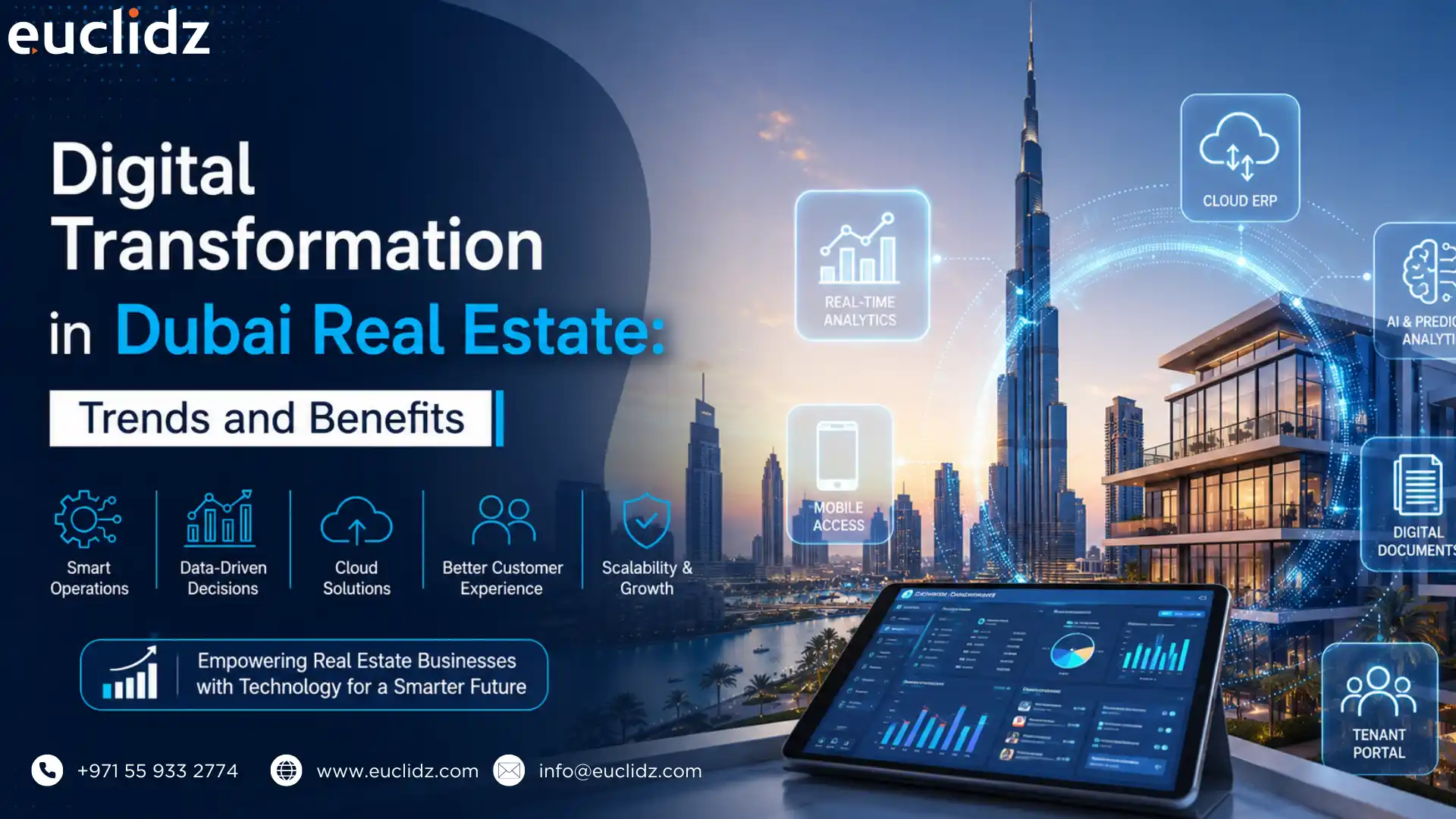
Dubai’s real estate sector is becoming more technology-driven every year.
Property developers, brokers, and facility management companies now rely on digital systems to improve operations, reduce delays, and increase profitability.
Traditional spreadsheets and disconnected software are no longer enough.
Businesses need centralized systems that support sales, leasing, accounting, customer management, and reporting in one place.
Digital transformation helps companies automate repetitive tasks, improve customer experiences, and make faster business decisions.
The rise of AI, cloud ERP, mobile applications, and smart property platforms is changing how the industry operates.
Many firms are now partnering with a Digital Transformation Company in Dubai to modernize operations and stay competitive.
This shift is not only about technology.
It is about improving efficiency, reducing operational costs, and creating scalable business models for long-term growth.
Dubai’s property market is highly competitive.
Buyers and investors expect faster responses, digital communication, transparent transactions, and real-time updates.
Real estate companies that still rely on manual workflows face delays, data duplication, and operational inefficiencies.
Digital transformation solves these issues through automation and centralized management systems.
ERP software, AI tools, and cloud platforms help businesses connect departments and improve collaboration.
Sales teams can track leads faster.
Finance departments gain real-time reporting.
Property managers can monitor maintenance requests instantly.
Digital systems also improve customer satisfaction.
Clients can access property details, documents, invoices, and updates through online portals and mobile applications.
Dubai’s smart city initiatives are also pushing businesses toward advanced technology adoption.
Companies using digital platforms gain advantages such as:
Technology is now a core business requirement in real estate.
Companies that delay digital adoption risk losing market share to faster and more agile competitors.
Artificial intelligence is changing how real estate companies analyze data and forecast market trends.
AI systems help businesses predict customer behavior, pricing trends, occupancy rates, and investment opportunities.
Real estate firms can use predictive analytics to identify high-performing locations and optimize marketing campaigns.
AI-powered chatbots also improve customer communication.
They answer inquiries instantly and reduce response times.
Lead scoring systems help sales teams focus on high-value prospects.
This improves conversion rates and reduces manual work.
AI also supports fraud detection and document verification.
As Dubai’s property market grows, AI-driven insights will become essential for strategic planning and competitive positioning.
Several technologies are shaping the future of Dubai real estate.
Businesses are investing heavily in automation, cloud infrastructure, and integrated ERP systems.
One major trend is cloud-based property management.
Cloud systems allow businesses to access operations from anywhere.
Teams can manage leasing, maintenance, finance, and customer communication in real time.
Mobile accessibility has also become important.
Real estate professionals need access to dashboards, reports, and approvals while working remotely or visiting sites.
Automation is another major trend.
Tasks such as invoicing, payment reminders, lease renewals, and document approvals can now run automatically.
This reduces errors and improves productivity.
Smart CRM systems help companies manage leads and customer interactions efficiently.
Integrated CRM platforms improve follow-ups and increase sales opportunities.
Data analytics is also becoming a priority.
Companies use dashboards and reports to track occupancy rates, revenue performance, and operational KPIs.
Key digital trends include:
Businesses implementing these solutions gain better operational control and long-term scalability.
Cloud-based systems eliminate the limitations of traditional on-premise software.
Real estate businesses can securely access data from any location.
This is important for companies managing multiple properties across Dubai and the UAE.
Cloud ERP platforms improve collaboration between departments.
Finance teams, property managers, and sales teams work from the same centralized database.
Updates happen instantly.
Cloud systems also reduce infrastructure costs.
Businesses no longer need expensive local servers or complex maintenance processes.
Security updates and backups are handled automatically.
Another advantage is scalability.
Companies can add new users, properties, and workflows without rebuilding their entire system.
This flexibility supports business expansion and operational growth.
Digital transformation improves efficiency across every stage of real estate operations.
One major benefit is automation.
Manual processes consume time and increase the risk of human error.
Automated systems reduce repetitive tasks and improve productivity.
Real-time reporting is another major advantage.
Business leaders can track financial performance, sales metrics, occupancy rates, and operational KPIs instantly.
Customer experience also improves significantly.
Clients expect fast communication and transparent processes.
Digital portals provide access to contracts, invoices, payment updates, and property information.
Digital systems also improve internal collaboration.
Departments work from centralized platforms instead of disconnected spreadsheets and emails.
This improves accountability and operational accuracy.
Key business benefits include:
Companies implementing modern ERP solutions often see measurable improvements in efficiency and profitability.
Many businesses now adopt Real Estate ERP Software in Dubai to centralize operations and support growth.
Automation improves both leasing and sales workflows.
Real estate firms can automate:
This reduces delays and improves customer response times.
Sales teams spend less time on administrative work and more time closing deals.
Automated workflows also reduce missed opportunities.
Every inquiry is tracked systematically.
Managers gain visibility into sales performance and pipeline activity through dashboards and reports.
This creates more consistent operations and improves overall business performance.
ERP systems connect multiple business functions into one centralized platform.
This is critical for real estate businesses handling complex operations.
A real estate ERP system typically includes:
Instead of using disconnected systems, businesses can manage operations from one dashboard.
ERP software improves data accuracy and eliminates duplication.
Finance teams can generate reports instantly.
Property teams can monitor repair requests, service updates, and maintenance activities instantly through centralized dashboards.
Executives gain better visibility into company-wide operations.
ERP platforms also improve compliance and audit readiness.
Digital records are easier to organize, access, and monitor.
For growing real estate businesses, ERP software supports scalability and operational consistency.
Cloud-based ERP systems further improve flexibility by enabling remote access and mobile functionality.
Businesses adopting ERP technology position themselves for faster growth and better operational control.
Mobile-enabled ERP systems improve business agility.
Real estate professionals often work outside the office.
They need access to reports, approvals, customer data, and property information on mobile devices.
Real-time reporting helps decision-makers respond faster.
Executives can monitor sales performance, financial reports, occupancy trends, and operational metrics instantly.
This reduces delays and improves strategic planning.
Mobile ERP platforms also improve communication between teams.
Approvals and updates happen faster, even when employees work remotely.
This flexibility supports modern business operations and improves overall efficiency.
Despite the benefits, many companies face challenges during digital transformation.
One major issue is resistance to change.
Staff members may initially struggle to adjust to unfamiliar digital platforms and updated operational processes.
Training becomes essential for successful implementation.
Data migration is another challenge.
Moving information from legacy systems to modern ERP platforms requires careful planning.
Cybersecurity is also a growing concern.
Real estate businesses manage sensitive financial and customer data.
Strong security measures are necessary to protect information and maintain compliance.
Budget limitations can also slow implementation.
However, cloud-based systems reduce infrastructure costs and make adoption more affordable.
Integration complexity is another factor.
Businesses often use multiple disconnected applications.
ERP implementation helps centralize these systems but requires proper planning and technical expertise.
Successful digital transformation requires:
Companies that plan properly achieve smoother transitions and stronger long-term results.
Real estate businesses store sensitive information including contracts, payment details, customer records, and legal documents.
Cybersecurity must be a priority.
Modern ERP systems include features such as:
Compliance is also important in Dubai’s regulated real estate market.
Digital systems help companies maintain accurate records and simplify reporting requirements.
Strong security practices build customer trust and reduce operational risks.
Dubai continues to invest heavily in smart city initiatives and advanced infrastructure.
This creates strong demand for digital real estate solutions.
AI, IoT, blockchain, and smart building technologies will continue expanding across the industry.
Future real estate platforms will become more connected and data-driven.
Businesses will rely on predictive analytics for pricing, investment planning, and customer engagement.
Virtual property experiences and automated transactions will also become more common.
Cloud ERP systems will remain central to operations.
Companies need scalable platforms that support remote work, automation, and real-time reporting.
Businesses that invest in digital transformation early gain stronger operational efficiency and long-term competitiveness.
Technology adoption is becoming a requirement rather than an option.
The future of Dubai real estate will be driven by intelligent systems, automation, and integrated digital operations.
Euclidz Technologies helps real estate businesses modernize operations through advanced ERP and digital transformation solutions.
The company supports businesses with:
Euclidz Technologies focuses on scalable and business-specific solutions.
This helps real estate firms improve operational visibility, reduce manual workloads, and increase efficiency.
Businesses looking for a trusted Digital Transformation Company in Dubai can benefit from customized technology solutions designed for the UAE market.
Companies seeking centralized operational control can also implement Real Estate ERP Software in Dubai to improve property management, finance, sales, and customer engagement.
Digital transformation is reshaping Dubai’s real estate industry.
ERP systems, automation, AI, and cloud platforms help businesses improve efficiency, customer experience, and operational control.
Companies adopting digital solutions gain stronger scalability and better decision-making capabilities.
As competition increases, technology adoption becomes essential for long-term growth.
Real estate firms that modernize operations today will be better positioned for future market demands.