 EuclidzEuclidz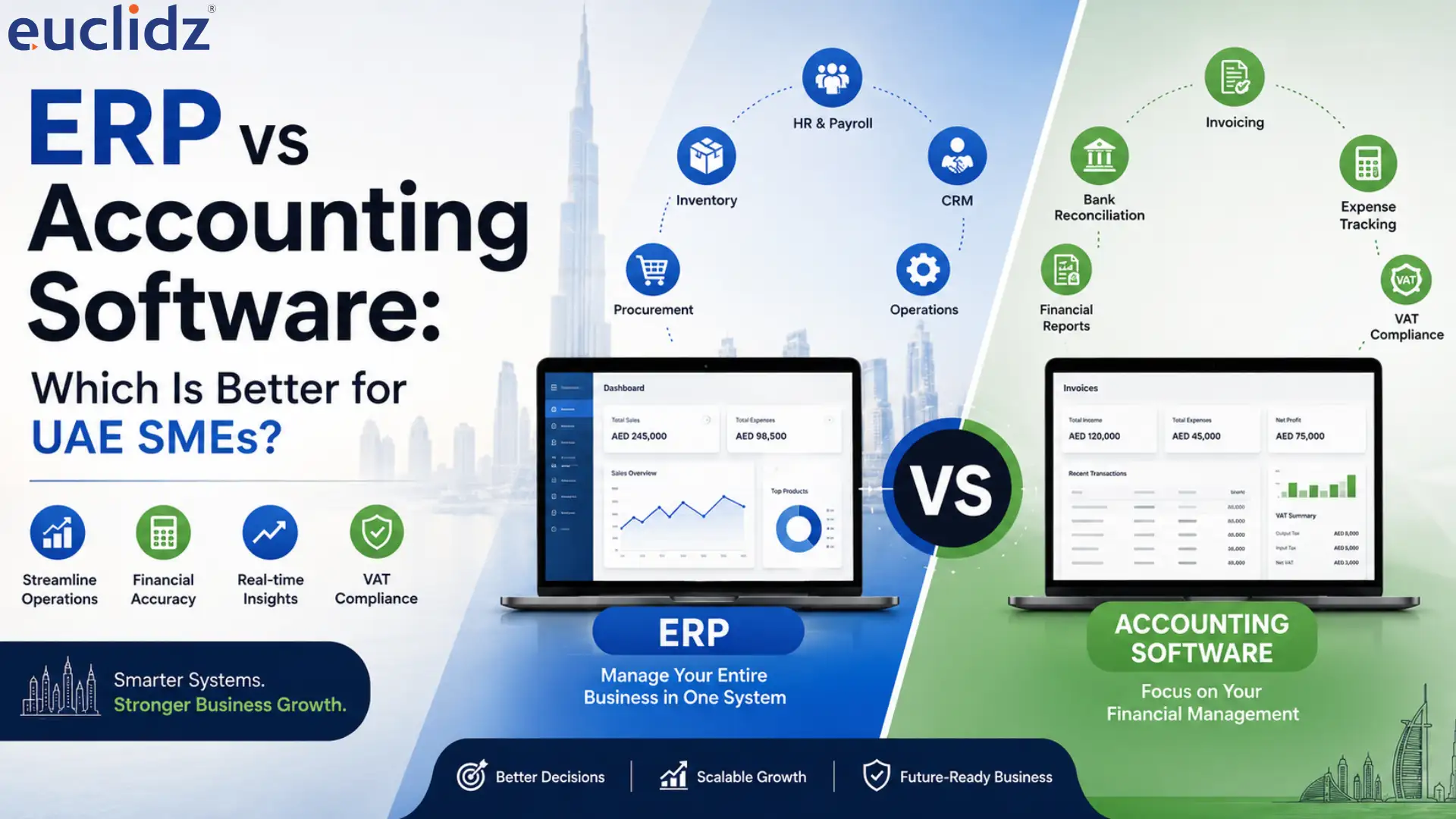
Running a business in the UAE requires more than basic bookkeeping.
SMEs must manage VAT compliance, payroll, inventory, reporting, customer data, and operations efficiently.
Many businesses begin with accounting software.
As operations grow, they often consider ERP systems.
The challenge is understanding which option fits the business stage, budget, and operational goals.
This guide explains the differences clearly.
It also helps UAE businesses decide which software delivers better long-term value.
Accounting software focuses mainly on financial management.
It helps businesses record transactions, manage invoices, track expenses, generate reports, and maintain VAT compliance.
For startups and small companies, accounting platforms are usually the first software investment.
These systems simplify bookkeeping and reduce manual spreadsheet work.
Popular accounting features include:
Many UAE SMEs prefer cloud-based systems because they support remote access and automatic backups.
Modern accounting software dubai solutions also integrate with payment gateways and POS systems.
Accounting software works best for businesses with:
However, accounting systems mainly focus on finance.
They often lack operational management features needed by growing businesses.
Accounting systems help businesses maintain financial accuracy.
Most platforms automate repetitive financial tasks.
This reduces human errors and improves reporting speed.
Key features include:
Many UAE businesses choose cloud accounting tools because they simplify FTA compliance.
Businesses can also generate tax-ready reports quickly.
This is especially useful during VAT filing periods.
Accounting software has scalability limits.
As businesses expand, departments become disconnected.
Finance data may remain separate from:
This creates duplicate data entry and operational delays.
For example, inventory updates may not reflect instantly in financial records.
Managers may rely on multiple software systems simultaneously.
That increases operational complexity.
Businesses experiencing rapid growth usually require broader automation tools.
ERP stands for Enterprise Resource Planning.
ERP software combines multiple business functions into one centralized platform.
Instead of managing separate systems, businesses control operations from a unified dashboard.
ERP systems commonly include:
ERP software improves communication between departments.
Data updates automatically across the organization.
For example, when sales teams generate invoices, inventory levels adjust instantly and finance records update automatically.
Businesses searching for advanced erp solutions dubai often choose cloud ERP systems because they improve operational visibility and scalability.
ERP platforms are especially useful for:
ERP systems offer modular flexibility.
Businesses can activate only the functions they require.
Core ERP modules usually include:
This centralized structure improves reporting accuracy.
Decision-makers gain real-time operational visibility.
Instead of reviewing separate reports from multiple systems, managers can analyze everything from one interface.
ERP systems reduce software fragmentation.
Data flows automatically between departments.
This improves efficiency and reduces repetitive tasks.
Examples include:
ERP integration also improves forecasting accuracy.
Management teams can identify operational bottlenecks faster.
For UAE SMEs planning expansion, ERP creates stronger long-term operational control.
The biggest difference is scope.
Accounting software handles finance.
ERP manages the entire business.
| Feature | Accounting Software | ERP Software |
|---|---|---|
| Financial Management | Yes | Yes |
| Inventory Management | Limited | Advanced |
| HR & Payroll | Basic | Full |
| CRM | Rare | Included |
| Real-Time Analytics | Limited | Advanced |
| Workflow Automation | Minimal | Extensive |
| Department Integration | No | Yes |
| Scalability | Moderate | High |
| Business Intelligence | Limited | Strong |
Accounting software is cheaper initially.
ERP delivers broader long-term value.
Businesses with growing operational complexity usually benefit more from ERP.
VAT compliance is mandatory for eligible UAE businesses.
Both accounting and ERP systems can support VAT reporting.
However, ERP platforms often provide deeper automation.
ERP systems can:
For companies managing large transaction volumes, ERP simplifies compliance significantly.
Cloud software dominates the UAE market.
Businesses prefer cloud platforms because they:
On-premise systems still exist for businesses requiring stricter internal control.
However, SMEs increasingly prefer cloud ERP and cloud accounting platforms due to lower upfront investment.
Accounting software offers affordability and simplicity.
Small businesses can deploy systems quickly without large implementation costs.
Key benefits include:
For startups, accounting systems provide enough functionality during early growth stages.
They also require less employee training compared to ERP platforms.
Many SMEs begin with accounting tools before upgrading later.
Accounting software supports moderate business growth.
However, expansion eventually creates operational gaps.
As transaction volumes increase, businesses often require:
At this stage, ERP becomes more practical.
Businesses should evaluate scalability before selecting software.
Choosing flexible platforms reduces future migration challenges.
ERP improves operational efficiency across the organization.
Instead of isolated departments, businesses create connected workflows.
Key ERP advantages include:
ERP systems also improve productivity.
Employees spend less time on repetitive tasks.
Management gains clearer operational visibility.
This supports faster business growth.
ERP implementation requires planning.
Businesses must:
Implementation complexity depends on company size and operational requirements.
Working with experienced ERP providers reduces deployment risks significantly.
Businesses should consider ERP when:
ERP is not only for large enterprises anymore.
Modern cloud ERP systems now offer affordable options for SMEs.
Businesses that delay digital transformation may face efficiency problems later.
Before selecting software, SMEs should ask:
These questions help businesses avoid costly mistakes.
Accounting software typically has lower upfront costs.
ERP systems require larger investments due to:
However, ERP often reduces long-term operational costs through automation and efficiency improvements.
SMEs should evaluate:
The cheapest option is not always the most cost-effective long term.
ERP provides strong value for:
Industries with inventory-heavy operations benefit the most.
ERP improves inventory accuracy, procurement planning, and operational coordination.
Service-based businesses with simpler workflows may initially benefit more from accounting software.
Software selection depends on:
Small startups may only require accounting systems initially.
Growing SMEs often achieve better efficiency with ERP.
Businesses should prioritize:
Choosing the wrong software can increase operational costs later.
A long-term strategy is important.
There is no universal answer.
Accounting software works well for small businesses with straightforward financial operations.
ERP becomes more valuable as operational complexity increases.
For UAE SMEs planning growth, ERP offers stronger scalability, automation, and business visibility.
Businesses focused mainly on bookkeeping may find accounting software sufficient initially.
The best decision depends on growth goals, workflows, and operational requirements.
Companies investing in digital transformation today position themselves for stronger long-term efficiency and competitiveness.